Diets restricting carbohydrate consumption
This article is about low-carbohydrate dieting as a lifestyle choice or for weight loss. For information on low-carbohydrate dieting as a therapy for epilepsy, see Ketogenic diet.
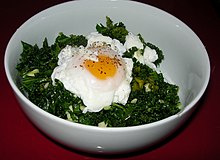
An example low-carbohydrate dish, kale and poached eggs
Low-carbohydrate diets restrict carbohydrate consumption relative to the average diet. Foods high in carbohydrates (e.g., sugar, bread, pasta) are limited, and replaced with foods containing a higher percentage of fat and protein (e.g., meat, poultry, fish, shellfish, eggs, cheese, nuts, and seeds), as well as low carbohydrate foods (e.g. spinach, kale, chard, collards, and other fibrous vegetables).
There is a lack of standardization of how much carbohydrate low-carbohydrate diets must have, and this has complicated research.[1] One definition, from the American Academy of Family Physicians, specifies low-carbohydrate diets as having less than 20% carbohydrate content.[2]
There is no good evidence that low-carbohydrate dieting confers any particular health benefits apart from weight loss, where low-carbohydrate diets achieve outcomes similar to other diets, as weight loss is mainly determined by calorie restriction and adherence.[3]
An extreme form of low-carbohydrate diet called the ketogenic diet was first established as a medical diet for treating epilepsy.[4] It became a popular fad diet for weight loss through celebrity endorsement, but there is no evidence of any distinctive benefit for this purpose and the diet carries a risk of adverse effects,[4] [5] with the British Dietetic Association naming it one of the "top five worst celeb diets to avoid" in 2018.[4]
Definition and classification [edit]
Macronutrient ratios [edit]
The macronutrient ratios of low-carbohydrate diets are not standardized.[6] [7] As of 2018[update] the conflicting definitions of "low-carbohydrate" diets have complicated research into the subject.[1] [8]
The National Lipid Association and Lifestyle Task force define low-carbohydrate diets and those containing less than 25% of calories from carbohydrates, and very low carbohydrate diets being those containing less than 10% carbohydrates.[9] A 2016 review of low-carbohydrate diets classified diets with 50g of carbohydrate per day (less than 10% of total calories) as "very low" and diets with 40% of calories from carbohydrates as "mild" low-carbohydrate diets.[10] The UK National Health Service recommend that "carbohydrates should be the body's main source of energy in a healthy, balanced diet."[11]
Foodstuffs [edit]

Like other leafy vegetables, curly kale is a food that is low in carbohydrates.
There is evidence that the quality, rather than the quantity, of carbohydrate in a diet is important for health, and that high-fiber slow-digesting carbohydrate-rich foods are healthful while highly refined and sugary foods are less so.[12] People choosing diet for health conditions should have their diet tailored to their individual requirements.[13] For people with metabolic conditions, a diet with approximately 40-50% carbohydrate is recommended.[13]
Most vegetables are low- or moderate-carbohydrate foods (in some low-carbohydrate diets, fiber is excluded because it is not a nutritive carbohydrate). Some vegetables, such as potatoes, carrots, maize (corn) and rice are high in starch. Most low-carbohydrate diet plans accommodate vegetables such as broccoli, spinach, kale, lettuce, cucumbers, cauliflower, peppers and most green-leafy vegetables.
Adoption and advocacy [edit]
The National Academy of Medicine recommends a daily average of 130 g of carbohydrates per day.[14] The FAO and WHO similarly recommend that the majority of dietary energy come from carbohydrates.[15] [16] Low-carbohydrate diets are not an option recommended in the 2015–2020 edition of Dietary Guidelines for Americans, which instead recommends a low-fat diet.
Carbohydrate has been wrongly accused of being a uniquely "fattening" macronutrient, misleading many dieters into compromising the nutritiousness of their diet by eliminating carbohydrate-rich food.[17] Low-carbohydrate diet proponents emphasize research saying that low-carbohydrate diets can initially cause slightly greater weight loss than a balanced diet, but any such advantage does not persist.[17] [18] In the long-term successful weight maintenance is determined by calorie intake, and not by macronutrient ratios.[19] [18]
The public has become confused by the way in which some diets, such as the Zone diet and the South Beach diet are promoted as "low-carbohydrate" when in fact they would more properly be termed "medium-carbohydrate" diets.[20]
Carbohydrate-insulin hypothesis [edit]
Low-carbohydrate diet advocates including Gary Taubes and David Ludwig have proposed a "carbohydrate-insulin hypothesis" in which carbohydrates are said to be uniquely fattening because they raise insulin levels and cause fat to accumulate unduly.[21] [22] The hypothesis appears to run counter to known human biology whereby there is no good evidence of any such association between the actions of insulin, fat accumulation, and obesity.[18] The hypothesis predicted that low-carbohydrate dieting would offer a "metabolic advantage" of increased energy expenditure equivalent to 400-600 kcal(kilocalorie)/day, in accord with the promise of the Atkin's diet: a "high calorie way to stay thin forever."[21]
With funding from the Laura and John Arnold Foundation, in 2012 Taubes co-founded the Nutrition Science Initiative (NuSI), with the aim of raising over $200 million to undertake a "Manhattan Project For Nutrition" and validate the hypothesis.[23] [24] Intermediate results, published in the American Journal of Clinical Nutrition did not provide convincing evidence of any advantage to a low-carbohydrate diet as compared to diets of other composition. This study revealed a marginal (∼100 kcal/d) but statistically significant effect of the ketogenic diet to increase 24-hour energy expenditure measured in a respiratory chamber, but the effect waned over time. Ultimately a very low-calorie, ketogenic diet (of 5% carbohydrate) "was not associated with significant loss of fat mass" compared to a non-specialized diet with the same calories; there was no useful "metabolic advantage."[18] [21] In 2017 Kevin Hall, a NIH (National Institutes of Health) researcher hired to assist with the project, wrote that the carbohydrate-insulin hypothesis had been falsified by experiment.[22] [21] Hall wrote "the rise in obesity prevalence may be primarily due to increased consumption of refined carbohydrates, but the mechanisms are likely to be quite different from those proposed by the carbohydrate–insulin model."[21]
Health aspects [edit]
Adherence [edit]
It has been repeatedly found that in the long-term, all diets with the same calorific value perform the same for weight loss, except for the one differentiating factor of how well people can faithfully follow the dietary programme.[20] A study comparing groups taking low-fat, low-carbohydrate and Mediterranean diets found at six months the low-carbohydrate diet still had most people adhering to it, but thereafter the situation reversed: at two years the low-carbohydrate group had the highest incidence of lapses and dropouts.[20] This may be due to the comparatively limited food choice of low-carbohydrate diets.[20]
Body weight [edit]
In the short and medium term, people taking a low-carbohydrate diet can experience more weight loss than people taking a low-fat diet.[25] Such people have very slightly more weight loss initially, equivalent to approximately 100kcal/day, but that the advantage diminishes over time and is ultimately insignificant.[18] The Endocrine Society stated that "when calorie intake is held constant [...] body-fat accumulation does not appear to be affected by even very pronounced changes in the amount of fat vs. carbohydrate in the diet."[18]
Much of the research comparing low-fat vs. low-carbohydrate dieting has been of poor quality and studies which reported large effects have garnered disproportionate attention in comparison to those which are methodologically sound.[26] A 2018 review said "higher-quality meta-analyses reported little or no difference in weight loss between the two diets."[26] Low-quality meta-analyses have tended to report favourably on the effect of low-carbohydrate diets: a systematic review reported that 8 out of 10 meta-analyses assessed whether weight loss outcomes could have been affected by publication bias, and 7 of them concluded positively.[26] A 2017 review concluded that a variety of diets, including low-carbohydrate diets, achieve similar weight loss outcomes, which are mainly determined by calorie restriction and adherence rather than the type of diet.[3]
Cardiovascular health [edit]
Low-carbohydrate dieting tends to raise levels of LDL cholesterol, but it is unclear how this might affect cardiovascular health.[27] [28] Potential favorable changes in triglyceride and HDL cholesterol values should be weighed against potential unfavorable changes in LDL and total cholesterol values.[29]
Some randomized control trials have shown that low-carbohydrate diets, especially very low-carbohydrate diets, perform better than low-fat diets in improving cardiometabolic risk factors in the long term, suggesting that low-carbohydrate diets are a viable option alongside low-fat diets for people at risk of cardiovascular disease.[30]
There is only poor-quality evidence of the effect of different diets on reducing or preventing high blood pressure, but it suggests the low-carbohydrate diet is among the better-performing ones, while the DASH diet (Dietary Approaches to Stop Hypertension) performs best.[31]
Diabetes [edit]
There is limited evidence for the effectiveness of low-carbohydrate diets for people with type 1 diabetes.[1] For certain individuals, it may be feasible to follow a low-carbohydrate regime combined with carefully managed insulin dosing. This can be hard to maintain and there are concerns about potential adverse health effects caused by the diet.[1] In general, people with type 1 diabetes are advised to follow an individualized eating plan.[1]
The proportion of carbohydrate in a diet is not linked to the risk of type 2 diabetes, although there is some evidence that diets containing certain high-carbohydrate items – such as sugar-sweetened drinks or white rice – are associated with an increased risk.[32] Some evidence indicates that consuming fewer carbohydrate foods may reduce biomarkers of type 2 diabetes.[33] [34]
A in 2019 consensus report on nutrition therapy for adults with diabetes and prediabetes the American Diabetes Association (ADA) states "Reducing overall carbohydrate intake for individuals with diabetes has demonstrated the most evidence for improving glycemia (blood sugar) and may be applied in a variety of eating patterns that meet individual needs and preferences.", it also states that reducing overall carbohydrate intake with low- or very low- carbohydrate eating plans is a viable approach.[35] While a other source states that there is no good evidence that low-carbohydrate diets are better than a conventional healthy diet in which carbohydrates typically account for more than 40% of calories consumed.[36] Low-carbohydrate dieting has no effect on the kidney function of people who have type 2 diabetes.[37]
Limiting carbohydrate consumption generally results in improved glucose control, although without long-term weight loss.[38] Low-carbohydrate diets can be useful to help people with type 2 diabetes lose weight, but "no single approach has been proven to be consistently superior."[39] According to the ADA, people with diabetes should be "developing healthy eating patterns rather than focusing on individual macronutrients, micronutrients, or single foods." They recommended that the carbohydrates in a diet should come from "vegetables, legumes, fruits, dairy (milk and yogurt), and whole grains", while highly refined foods and sugary drinks should be avoided.[39] The ADA also wrote that "reducing overall carbohydrate intake for individuals with diabetes has demonstrated the most evidence for improving glycemia and may be applied in a variety of eating patterns that meet individual needs and preferences." For individuals with type 2 diabetes who can't meet the glycemic targets or where reducing anti-glycemic medications is a priority, the ADA says that low or very-low carbohydrate diets are a viable approach.[40]
Exercise and fatigue [edit]
A low-carbohydrate diet has been found to reduce endurance capacity for intense exercise efforts, and depleted muscle glycogen following such efforts is only slowly replenished if a low-carbohydrate diet is taken.[41] Inadequate carbohydrate intake during athletic training causes metabolic acidosis, which may be responsible for the impaired performance which has been observed.[41]
Safety [edit]
High and low-carbohydrate diets that are rich in animal-derived proteins and fats may be associated with increased mortality. Conversely, with plant-derived proteins and fats, there may be a decrease of mortality.[42]
As of 2018[update], research has paid insufficient attention to the potential adverse effects of carbohydrate restricted dieting, particularly for micronutrient sufficiency, bone health and cancer risk.[26] One low-quality meta-analysis reported that adverse effects could include "constipation, headache, halitosis, muscle cramps and general weakness."[26]
In a comprehensive systematic review of 2018, Churuangsuk and colleagues reported that other case reports give rise to concerns of other potential risks of low-carbohydrate dieting including hyperosmolar coma, Wernicke's encephalopathy, optic neuropathy from thiamine deficiency, acute coronary syndrome and anxiety disorder.[26]
A 2021 study from Japan looked at the long-term aspects of low-carb eating. The study included 90.171 participants with a median 17 years of follow-up. The study found that a high adherence to low-carb eating was associated with increased overall cancer risk. Looking at the diet composition the authors found that eating more animals foods was associated with an increased cancer risk while plant fat consumption was not.[43]
Ketosis induced by a low-carbohydrate diet has led to reported cases of ketoacidosis, a life-threatening condition.[1] [44] This has led to the suggestion that ketoacidosis should be considered a potential hazard of low-carbohydrate dieting.[26]
Significantly restricting the proportion of carbohydrate in diet risks causing malnutrition, and can make it difficult to get enough dietary fiber to stay healthy.[11]
As of 2014, it appeared that with respect to the risk of death for people with cardiovascular disease, the kind of carbohydrates consumed are important; diets relatively higher in fiber and whole grains lead to reduced risk of death from cardiovascular disease compared to diets high in refined grains.[45]
History [edit]

A low-carbohydrate diet restricts the amount of carbohydrate-rich foods – such as bread – in the diet.
First descriptions [edit]
In 1797, John Rollo reported on the results of treating two diabetic Army officers with a low-carbohydrate diet and medications. A very low-carbohydrate, ketogenic diet was the standard treatment for diabetes throughout the nineteenth century.[46] [47]
In 1863, William Banting, a formerly obese English undertaker and coffin maker, published "Letter on Corpulence Addressed to the Public," in which he described a diet for weight control giving up bread, butter, milk, sugar, beer, and potatoes.[48] His booklet was widely read, so much so that some people used the term "Banting" for the activity now called "dieting."[49]
Physicians who advocated a low-carbohydrate diet consisting of large amounts of animal fat and protein to treat diabetes in the late 1800s include James Lomax Bardsley, Apollinaire Bouchardat and Frederick William Pavy.[50] [51]
In the early 1900s Frederick Madison Allen developed a highly restrictive short term regime which was described by Walter R. Steiner at the 1916 annual convention of the Connecticut State Medical Society as The Starvation Treatment of Diabetes Mellitus.[52] : 176–177 [53] [54] This diet was often administered in a hospital in order to better ensure compliance and safety.[52] : 179
Modern low-carbohydrate diets [edit]
Other low-carbohydrate diets in the 1960s included the Air Force diet,[55] "Martinis & Whipped Cream" in 1966,[56] and the Drinking Man's Diet.[57] In 1972, Robert Atkins published Dr. Atkins' Diet Revolution, which advocated the low-carbohydrate diet he had successfully used in treating people in the 1960s.[58] The book was a publishing success, but was widely criticized by the mainstream medical community as being dangerous and misleading, thereby limiting its appeal at the time.[59]
The concept of the glycemic index was developed in 1981 by David Jenkins to account for variances in speed of digestion of different types of carbohydrates. This concept classifies foods according to the rapidity of their effect on blood sugar levels – with fast-digesting simple carbohydrates causing a sharper increase and slower-digesting complex carbohydrates, such as whole grains, a slower one.[60] Jenkins's research laid the scientific groundwork for subsequent low-carbohydrate diets.[61]
In 1992, Atkins published an update from his 1972 book, Dr. Atkins' New Diet Revolution, and other doctors began to publish books based on the same principles.[62] During the late 1990s and early 2000s, low-carbohydrate diets became some of the most popular diets in the US. By some accounts, up to 18% of the population was using one type of low-carbohydrate diet or another at the peak of their popularity.[63] Food manufacturers and restaurant chains noted the trend, as it affected their businesses.[64] Parts of the mainstream medical community have denounced low-carbohydrate diets as being dangerous to health, such as the AHA in 2001,[65] and the American Kidney Fund in 2002.[66] [ failed verification ]
Ketogenic diet [edit]
The ketogenic diet is a high-fat, low-carbohydrate diet used to treat drug-resistant childhood epilepsy.[67] The premise of the ketogenic diet for weight loss is that if the body is deprived of glucose obtained from carbohydrate foods, it will produce energy from stored fat.[68]
In the 2010s, the ketogenic diet became a fad diet for people wanting to lose weight.[68] The keto diet became popular through celebrity endorsement, but there is no evidence of any distinctive benefit for this purpose, and the diet carries a risk of adverse effects,[4] [5] with the British Dietetic Association naming it one of the "top five worst celeb diets to avoid" in 2018.[4]
According to dietitian Keri Gans, the "keto diet" was the most popularly searched for diet on Google in 2018.[69] In 2021, it was ranked by U.S. News & World Report 37th (tie) out of 39 best diets overall, and 4th in best fast weight-loss diets.[70]
Users of the ketogenic diet may not achieve sustainable weight loss, as this requires strict carbohydrate abstinence, and maintaining the diet is difficult.[36] [68] Side effects may include constipation, high cholesterol, growth slowing, acidosis, and kidney stones.[5]
It has been hypothesized that some people have an atypical metabolism, and would therefore benefit metabolically from adopting a ketogenic diet, but as of 2020[update] there had been no long-term research into this.[25]
See also [edit]
- Gluconeogenesis – The formation of glucose from noncarbohydrate precursors, such as pyruvate, amino acids and glycerol.
- Insulin resistance
- KE diet
- Low-fiber/low-residue diet – Diet that limits stool
- Protein-sparing modified fast – Type of diet
- Richard K. Bernstein
References [edit]
- ^ a b c d e f Seckold R, Fisher E, de Bock M, King BR, Smart CE (October 2018). "The ups and downs of low-carbohydrate diets in the management of Type 1 diabetes: a review of clinical outcomes". Diabet. Med. (Review). 36 (3): 326–334. doi:10.1111/dme.13845. PMID 30362180. S2CID 53102654.
Low‐carbohydrate diets are of interest for improving glycaemic outcomes in the management of Type 1 diabetes. There is limited evidence to support their routine use in the management of Type 1 diabetes.
- ^ Last AR, Wilson SA (June 2006). "Low-carbohydrate diets". American Family Physician. 73 (11): 1942–8. PMID 16770923. Archived from the original on 13 February 2020. Retrieved 23 February 2010.
- ^ a b Thom, G; Lean, M (May 2017). "Is There an Optimal Diet for Weight Management and Metabolic Health?" (PDF). Gastroenterology (Review). 152 (7): 1739–1751. doi:10.1053/j.gastro.2017.01.056. PMID 28214525. Archived (PDF) from the original on 19 July 2018. Retrieved 24 October 2019.
- ^ a b c d e "Top 5 worst celeb diets to avoid in 2018". British Dietetic Association. 7 December 2017. Archived from the original on 6 February 2020. Retrieved 6 February 2020.
The British Dietetic Association (BDA) today revealed its much-anticipated annual list of celebrity diets to avoid in 2018. The line-up this year includes Raw Vegan, Alkaline, Pioppi and Ketogenic diets as well as Katie Price's Nutritional Supplements.
- ^ a b c Kossoff EH, Wang HS. Dietary therapies for epilepsy. Biomed J. 2013 Jan-Feb;36(1):2-8. doi:10.4103/2319-4170.107152 PMID 23515147
- ^ Westman EC, Feinman RD, Mavropoulos JC, Vernon MC, Volek JS, Wortman JA, Yancy WS, Phinney SD (2007). "Low-carbohydrate nutrition and metabolism". Am. J. Clin. Nutr. (Review). 86 (2): 276–84. doi:10.1093/ajcn/86.2.276. PMID 17684196.
- ^ Feinman RD, Pogozelski WK, Astrup A, Bernstein RK, Fine EJ, Westman EC, et al. (2015). "Dietary carbohydrate restriction as the first approach in diabetes management: critical review and evidence base". Nutrition (review). 31 (1): 1–13. doi:10.1016/j.nut.2014.06.011. PMID 25287761.
- ^ Forouhi NG, Misra A, Mohan V, Taylor R, Yancy W (2018). "Dietary and nutritional approaches for prevention and management of type 2 diabetes". BMJ. 361: k2234. doi:10.1136/bmj.k2234. PMC5998736. PMID 29898883.
- ^ Kirkpatrick CF, Bolick JP, Kris-Etherton PM, Sikand G, Aspry KE, Soffer DE, Willard KE, Maki KC (2019). "Review of current evidence and clinical recommendations on the effects of low-carbohydrate and very-low-carbohydrate (including ketogenic) diets for the management of body weight and other cardiometabolic risk factors: A scientific statement from the National Lipid Association Nutrition and Lifestyle Task Force". J Clin Lipidol. 13 (5): 689–711.e1. doi:10.1016/j.jacl.2019.08.003. PMID 31611148.
- ^ Hashimoto Y, Fukuda T, Oyabu C, Tanaka M, Asano M, Yamazaki M, Fukui M (2016). "Impact of low-carbohydrate diet on body composition: meta-analysis of randomized controlled studies". Obes Rev (Review). 17 (6): 499–509. doi:10.1111/obr.12405. PMID 27059106. S2CID 46716650.
- ^ a b "Healthy Weight—The truth about carbs". National Health Service. 19 December 2018. Archived from the original on 21 December 2018. Retrieved 21 December 2018.
- ^ Reynolds A, Mann J, Cummings J, Winter N, Mete E, Te Morenga L (10 January 2019). "Carbohydrate quality and human health: a series of systematic reviews and meta-analyses" (PDF). Lancet (Review). 393 (10170): 434–445. doi:10.1016/S0140-6736(18)31809-9. PMID 30638909. S2CID 58632705. Archived (PDF) from the original on 27 September 2019. Retrieved 27 September 2019.
- ^ a b Giugliano D, Maiorino MI, Bellastella G, Esposito K (2018). "More sugar? No, thank you! The elusive nature of low carbohydrate diets". Endocrine (Review). 61 (3): 383–387. doi:10.1007/s12020-018-1580-x. PMID 29556949. S2CID 4032074.
- ^ "Dietary Reference Intakes (DRIs)" (PDF). National Academy of Medicine. Archived from the original (PDF) on 19 October 2015. Retrieved 31 August 2015.
- ^ Food and Nutrition Board (2002/2005). Dietary Reference Intakes for Energy, Carbohydrate, Fiber, Fat, Fatty Acids, Cholesterol, Protein, and Amino Acids. Washington, DC: The National Academies Press. Page 769 Archived 12 September 2006 at the Wayback Machine. ISBN 0-309-08537-3
- ^ Joint WHO/FAO expert consultation (2003). Diet, Nutrition and the Prevention of Chronic Diseases (PDF). who.int. Geneva: World Health Organization. pp. 55–56. ISBN978-92-4-120916-8. Archived from the original (PDF) on 4 April 2003.
- ^ a b Sizer FS, Whitney E (2016). Nutrition Concepts and Controversies (14th ed.). Brooks Cole. pp. 119, 367. ISBN978-0-495-22011-4.
- ^ a b c d e f Schwartz MW, Seeley RJ, Zeltser LM, Drewnowski A, Ravussin E, Redman LM, et al. (2017). "Obesity Pathogenesis: An Endocrine Society Scientific Statement". Endocr Rev (Scientific statement). 38 (4): 267–296. doi:10.1210/er.2017-00111. PMC5546881. PMID 28898979.
- ^ Butryn ML, Clark VL, Coletta MC (2012). Akabas SR, et al. (eds.). Behavioral approaches to the treatment of obesity. Textbook of Obesity. John Wiley & Sons. p. 259. ISBN978-0-470-65588-7.
Taken together, these findings indicate that calorie intake, not macronutrient composition, determines long-term weight loss maintenance.
- ^ a b c d Nonas CA, Dolins KR (2012). Akabas SR, et al. (eds.). Dietary intervention approaches to the treatment of obesity. Textbook of Obesity. John Wiley & Sons. pp. 295–309. ISBN978-0-470-65588-7.
- ^ a b c d e Hall KD (2017). "A review of the carbohydrate-insulin model of obesity". Eur J Clin Nutr (Review). 71 (3): 323–326. doi:10.1038/ejcn.2016.260. PMID 28074888. S2CID 54484172.
- ^ a b Belluz J (20 February 2018). "We've long blamed carbs for making us fat. What if that's wrong?". Vox. Archived from the original on 24 December 2018. Retrieved 23 December 2018.
- ^ Barclay E (20 September 2012). "Billionaires Fund A 'Manhattan Project' For Nutrition And Obesity". WBUR News. Archived from the original on 2 July 2019. Retrieved 2 July 2019.
- ^ Waite E (8 August 2018). "The Struggles of a $40 Million Nutrition Science Crusade". Wired. Archived from the original on 23 December 2018. Retrieved 23 December 2018.
- ^ a b Ludwig DS, Willett WC, Volek JS, Neuhouser ML (November 2018). "Dietary fat: From foe to friend?". Science (Review). 362 (6416): 764–770. Bibcode:2018Sci...362..764L. doi:10.1126/science.aau2096. PMID 30442800.
- ^ a b c d e f g Churuangsuk C, Kherouf M, Combet E, Lean M (2018). "Low-carbohydrate diets for overweight and obesity: a systematic review of the systematic reviews" (PDF). Obes Rev (Systematic review). 19 (12): 1700–1718. doi:10.1111/obr.12744. PMID 30194696. S2CID 52174104. Archived (PDF) from the original on 23 September 2019. Retrieved 4 October 2019.
- ^ Ludwig DS (June 2020). "The Ketogenic Diet: Evidence for Optimism but High-Quality Research Needed". J. Nutr. (Review). 150 (6): 1354–1359. doi:10.1093/jn/nxz308. PMC7269727. PMID 31825066.
- ^ Mansoor N, Vinknes KJ, Veierød MB, Retterstøl K (February 2016). "Effects of low-carbohydrate diets v. low-fat diets on body weight and cardiovascular risk factors: a meta-analysis of randomised controlled trials". The British Journal of Nutrition. 115 (3): 466–79. doi:10.1017/S0007114515004699. PMID 26768850. S2CID 21670516.
- ^ Hu T, Mills KT, Yao L, Demanelis K, Eloustaz M, Yancy WS, Kelly TN, He J, Bazzano LA (October 2012). "Effects of low-carbohydrate diets versus low-fat diets on metabolic risk factors: a meta-analysis of randomized controlled clinical trials". American Journal of Epidemiology. 176 Suppl 7 (Suppl 7): S44–54. doi:10.1093/aje/kws264. PMC3530364. PMID 23035144.
- ^ Gjuladin-Hellon T, Davies IG, Penson P, Amiri Baghbadorani R (2018). "Effects of carbohydrate-restricted diets on low-density lipoprotein cholesterol levels in overweight and obese adults: a systematic review and meta-analysis" (PDF). Nutr Rev (Systematic review). 77 (3): 161–180. doi:10.1093/nutrit/nuy049. PMID 30544168. S2CID 56488132. Archived (PDF) from the original on 6 May 2020. Retrieved 19 April 2020.
- ^ Schwingshackl L, Chaimani A, Schwedhelm C, Toledo E, Pünsch M, Hoffmann G, et al. (2018). "Comparative effects of different dietary approaches on blood pressure in hypertensive and pre-hypertensive patients: A systematic review and network meta-analysis". Crit Rev Food Sci Nutr (Systematic Review). 59 (16): 2674–2687. doi:10.1080/10408398.2018.1463967. PMID 29718689.
- ^ Public Health England (2015). "Carbohydrates and Health" (Report). Scientific Advisory Council on Nutrition: 57, 85. Archived from the original on 21 December 2018. Retrieved 21 December 2018 – via The Stationery Office.
No significant association was found between total carbohydrate intake as g/day and incidence of type 2 diabetes mellitus.
- ^ Meng Y, Bai H, Wang S, Li Z, Wang Q, Chen L (2017). "Efficacy of low carbohydrate diet for type 2 diabetes mellitus management: A systematic review and meta-analysis of randomized controlled trials". Diabetes Research and Clinical Practice. 131: 124–131. doi:10.1016/j.diabres.2017.07.006. PMID 28750216.
- ^ van Zuuren EJ, Fedorowicz Z, Kuijpers T, Pijl H (August 2018). "Effects of low-carbohydrate- compared with low-fat-diet interventions on metabolic control in people with type 2 diabetes: a systematic review including GRADE assessments". The American Journal of Clinical Nutrition. 108 (2): 300–331. doi:10.1093/ajcn/nqy096. PMID 30007275.
- ^ Evert, Alison B. (May 2019). "Nutrition Therapy for Adults With Diabetes or Prediabetes: A Consensus Report". Diabetes Care. 42 (5): 731–754. doi:10.2337/dci19-0014. PMC7011201. PMID 31000505.
- ^ a b Brouns F (2018). "Overweight and diabetes prevention: is a low-carbohydrate-high-fat diet recommendable?". Eur J Nutr (Review). 57 (4): 1301–1312. doi:10.1007/s00394-018-1636-y. PMC5959976. PMID 29541907.
- ^ Suyoto PST (2018). "Effect of low-carbohydrate diet on markers of renal function in patients with type 2 diabetes: A meta-analysis". Diabetes Metab Res Rev (Meta-analysis). 34 (7): e3032. doi:10.1002/dmrr.3032. PMID 29904998. S2CID 49215700.
- ^ Meng Y, Bai H, Wang S, Li Z, Wang Q, Chen L (September 2017). "Efficacy of low carbohydrate diet for type 2 diabetes mellitus management: A systematic review and meta-analysis of randomized controlled trials". Diabetes Research and Clinical Practice. 131: 124–131. doi:10.1016/j.diabres.2017.07.006. PMID 28750216.
- ^ a b American Diabetes Association Professional Practice Committee (2019). "Professional Practice Committee: Standards of Medical Care in Diabetes—2019". Diabetes Care. 42 (Supplement 1): s46–s60. doi:10.2337/dc19-S005. PMID 30559231. Archived from the original on 18 December 2018. Retrieved 18 December 2018.
- ^ Evert AB, Dennison M, Gardner CD, Garvey WT, Lau KH, MacLeod J, et al. (May 2019). "Nutrition Therapy for Adults With Diabetes or Prediabetes: A Consensus Report". Diabetes Care (Professional society guidelines). 42 (5): 731–754. doi:10.2337/dci19-0014. PMC7011201. PMID 31000505.
- ^ a b Maughan RJ, Greenhaff PL, Leiper JB, Ball D, Lambert CP, Gleeson M (1997). "Diet composition and the performance of high-intensity exercise". J Sports Sci (Review). 15 (3): 265–75. doi:10.1080/026404197367272. PMID 9232552.
- ^ Seidelmann SB, Claggett B, Cheng S, Henglin M, Shah A, Steffen LM, et al. (2018). "Dietary carbohydrate intake and mortality: a prospective cohort study and meta-analysis". Lancet Public Health (Meta-analysis). 3 (9): e419–e428. doi:10.1016/S2468-2667(18)30135-X. PMC6339822. PMID 30122560.
- ^ Cai, Honglin; Sobue, Tomotaka; Kitamura, Tetsuhisa; Ishihara, Junko; Nanri, Akiko; Mizoue, Tetsuya; Iwasaki, Motoki; Yamaji, Taiki; Inoue, Manami; Tsugane, Shoichiro; Sawada, Norie (25 November 2021). "Low Carbohydrate Diet and Risk of Cancer Incidence: the Japan Public Health Center-based Prospective Study". Cancer Science. doi:10.1111/cas.15215. ISSN 1349-7006. PMID 34821435.
- ^ Ullah W, Hamid M, Mohammad Ammar Abdullah H, Ur Rashid M, Inayat F (January 2018). "Another "D" in MUDPILES? A Review of Diet-Associated Nondiabetic Ketoacidosis". Journal of Investigative Medicine High Impact Case Reports. 6: 232470961879626. doi:10.1177/2324709618796261. PMC6108016. PMID 30151400.
- ^ Hu T, Bazzano LA (April 2014). "The low-carbohydrate diet and cardiovascular risk factors: evidence from epidemiologic studies". Nutrition, Metabolism, and Cardiovascular Diseases. 24 (4): 337–43. doi:10.1016/j.numecd.2013.12.008. PMC4351995. PMID 24613757.
- ^ Morgan W (1877). Diabetes mellitus: its history, chemistry, anatomy, pathology, physiology, and treatment. Homoeopathic Publishing Company.
- ^ Einhorn M (1905). Lectures on dietetics. Saunders. Archived from the original on 29 August 2013. Retrieved 15 March 2020.
- ^ Banting W (1869). Letter On Corpulence, Addressed to the Public (4th ed.). London, England: Harrison. Archived from the original on 26 December 2007. Retrieved 2 January 2008.
- ^ Groves B (2002). "William Banting Father of the Low-Carbohydrate Diet". The Weston A. Price Foundation. Archived from the original on 1 December 2007. Retrieved 22 November 2007.
- ^ Furdell, Elizabeth Lane. (2009). Fatal Thirst: Diabetes in Britain Until Insulin. Brill. p. 125, pp. 138-139. ISBN 978-90-04-17250-0
- ^ Jörgens V, Porta M. (2020). Unveiling Diabetes: Historical Milestones in Diabetology. Karger. p. 11. ISBN 978-3-318-06733-0
- ^ a b Steiner WR (1916). "The Starvation Treatment of Diabetes Mellitus". Proceedings of the Connecticut State Medical Society: 176–184. Archived from the original on 24 September 2017. Retrieved 30 October 2016.
124th Annual Convention
- ^ Allen FM, Fitz R, Stillman E (1919). Total dietary regulation in the treatment of diabetes. New York: The Rockefeller Institute for Medical Research. Archived from the original on 10 May 2017. Retrieved 31 October 2016.
- ^ Another publication of similar regimen was Hill LW, Eckman RS (1915). The Starvation Treatment of Diabetes with a series of graduated diets as used at the Massachusetts General Hospital. Boston: W.M. Leonard.
- ^ Air Force Diet. Toronto, Canada: Air Force Diet Publishers. 1960.
- ^ Petrie, Sidney; Stone, Robert B. (1966). Martinis & Whipped Cream. Parker Publishing.
- ^ Jameson G, Williams E (2004). The Drinking Man's Diet. San Francisco: Cameron. ISBN978-0-918684-65-3.
- ^ Gordon E, Goldberg M, Chosy G (October 1963). "A New Concept in the Treatment of Obesity". JAMA. 186 (1): 50–60. doi:10.1001/jama.1963.63710010013014. PMID 14046659.
- ^ "A critique of low-carbohydrate ketogenic weight reduction regimens. A review of Dr. Atkins' diet revolution". JAMA. 224 (10): 1415–9. June 1973. doi:10.1001/jama.1973.03220240055018. PMID 4739993.
- ^ Jenkins DJ, Wolever TM, Taylor RH, Barker H, Fielden H, Baldwin JM, Bowling AC, Newman HC, Jenkins AL, Goff DV (March 1981). "Glycemic index of foods: a physiological basis for carbohydrate exchange". The American Journal of Clinical Nutrition. 34 (3): 362–6. doi:10.1093/ajcn/34.3.362. PMID 6259925.
- ^ Beck, Leslie (17 July 2018). "Why the man who brought us the glycemic index wants us to go vegan". The Globe And Mail. Archived from the original on 17 March 2019. Retrieved 9 November 2019.
- ^ "PBS News Hour: Low Carb Craze". Pbs.org. Archived from the original on 9 December 2011. Retrieved 18 December 2011.
- ^ Reinberg, Steven. "Americans Look for Health on the Menu: Survey finds nutrition plays increasing role in dining-out choices". Archived from the original on 28 September 2007. Retrieved 28 September 2007.
- ^ Schooler L (22 June 2004). "Low-Carb Diets Trim Krispy Kreme's Profit Line". Morning Edition. National Public Radio. Archived from the original on 8 March 2012. Retrieved 18 December 2011.
- ^ St Jeor ST, Howard BV, Prewitt TE, Bovee V, Bazzarre T, Eckel RH (October 2001). "Dietary protein and weight reduction: a statement for healthcare professionals from the Nutrition Committee of the Council on Nutrition, Physical Activity, and Metabolism of the American Heart Association". Circulation. 104 (15): 1869–74. doi:10.1161/hc4001.096152. PMID 11591629.
These diets are generally associated with higher intakes of total fat, saturated fat, and cholesterol because the protein is provided mainly by animal sources. ... Beneficial effects on blood lipids and insulin resistance are due to the weight loss, not to the change in caloric composition. ... High-protein diets may also be associated with increased risk for coronary heart disease due to intakes of saturated fat, cholesterol, and other associated dietary factors.
- ^ The American Kidney Fund: American Kidney Fund Warns About Impact of High-Protein Diets on Kidney Health: 25 April 2002
- ^ Martin-McGill, Kirsty J.; Bresnahan, Rebecca; Levy, Robert G.; Cooper, Paul N. (24 June 2020). "Ketogenic diets for drug-resistant epilepsy". The Cochrane Database of Systematic Reviews. 2020 (6): CD001903. doi:10.1002/14651858.CD001903.pub5. ISSN 1469-493X. PMC7387249. PMID 32588435.
- ^ a b c "Diet review: Ketogenic diet for weight loss". TH Chan School of Public Health, Harvard University. 2019. Archived from the original on 2 July 2019. Retrieved 30 June 2019.
- ^ Keri Gans (15 January 2019). "Google's top ten most popular diets 2018". U.S. News & World Report.
- ^ "Keto Diet". U.S. News Best Diets 2021 . Retrieved 6 January 2021.
Further reading [edit]
- Lowery R, Wilson J. The Ketogenic Bible: The Authoritative Guide to Ketosis.1st ed. Victory Belt Publishing; 2017. ISBN 9781628601046.